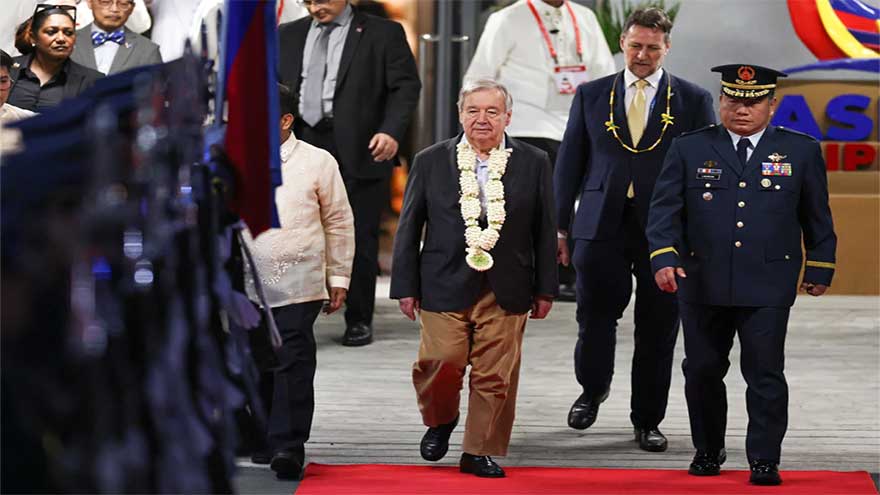
Summary US President Donald Trump is scheduled to arrive on Tuesday near the summit’s conclusion, a visit expected to include a sideline meeting with fellow Quad countries India, Japan and Australia
MANILA (Web Desk) - A key regional summit opens on Sunday in Manila, with Southeast Asian heads of state facing questions on trade, security and an ongoing energy crisis while playing host to a who’s who of global leaders.
US President Donald Trump is scheduled to arrive on Tuesday near the summit’s conclusion, a visit expected to include a sideline meeting with fellow Quad countries India, Japan and Australia — the first of his second term.
The meeting of the Quad — a grouping broadly aimed at counterbalancing China’s regional influence — would come days before a historic sit-down with Chinese leader Xi Jinping and Russia’s Vladimir Putin in Shenzhen.
Brazil’s recently re-elected Luiz Inacio Lula da Silva, meanwhile, is set to attend a plenary session of the 11-member Association of Southeast Asian Nations (ASEAN) on Sunday, while Australian Prime Minister Anthony Albanese will sign a new defense pact with host country the Philippines.
Nearly 20,000 police officers have been deployed around Metro Manila for the summit, with progressive groups predicting a turnout of thousands on Tuesday for an anti-Trump march on the summit site.
Much of the uproar targets the US Pax Silica program — a supply-chain initiative designed to counter China’s dominance in semiconductors and rare earths — whose flagship Philippine project, a 1,620-hectare AI manufacturing hub north of Manila, threatens to displace Indigenous families.
US Ambassador to the Philippines Lee Lipton said last week that a widely rumored November target date for a deal signing timed to Trump’s visit was never in the works.
Unfinished business A day of early meetings kicked off on Saturday with Canadian Prime Minister Mark Carney announcing a Philippine trade deal, and ASEAN leaders huddling on key issues including haze from Indonesia and potential fuel-sharing schemes as members struggle with Iran war-driven shortages.
But two issues that have vexed ASEAN leaders for years — a languishing South China Sea “Code of Conduct” and their relationship with war-torn Myanmar — look to be Singapore’s problem when the bloc’s rotating chair passes to the city-state in 2027.