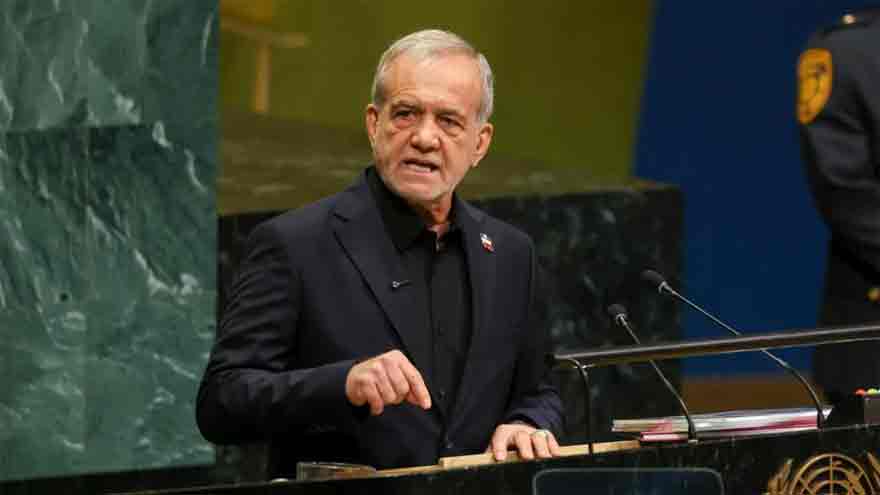
Summary "The resistance of the Iranian people will only increase in the face of sanctions, increased pressure, increased bullying," Pezeshkian told the UN General Assembly.
UNITED NATIONS (Web Desk) - President Masoud Pezeshkian has said Iran will never "bend the knee" after almost seven months of war with the US and Israel, but is ready for a diplomatic solution to the conflict.
Responding to US President Donald Trump's threat to "annihilate" the Islamic Republic if a deal is not reached soon, he told the UN General Assembly: "The resistance of the Iranian people will only increase in the face of sanctions, increased pressure, increased bullying."
Pezeshkian also insisted any deal would have to include an end to the US blockade stopping Iranian ships from using a key Gulf waterway.
"It cannot be the case that everyone benefits from the Strait of Hormuz while we are denied access," he said.
There was no immediate comment from the US, whose delegation walked out of the chamber at the start of Pezeshkian's address.
"The US president described us as terrorists. We have been the victims of terrorism," Iran's president told the UN in New York.
He then held up a photo of the country's late Supreme Leader, Ayatollah Ali Khamenei, who was killed in a strike on his residence when the US and Israel launched a joint attack in late February.
He also presented pictures of some of the more than 175 civilians, two thirds of them children, who Iranian authorities say were killed in missile strikes on a primary school in Minab and a sports complex in Lamerd that day. The US has denied striking Lamerd and said it is still investigating what happened in Minab.
"Our innocent people have been the targets of cowardly attacks and aggressions imposed on our country. And we defended ourselves with utmost strength," Pezeshkian said.
Also on Wednesday, an attack on a cargo ship in the Strait of Hormuz killed an Indian sailor, the Agence France-Presse news agency reported, citing Omani and Indian authorities.
The attack was condemned by India's foreign ministry, which called for unimpeded passage through the Strait to be restored.
In February, Iran retaliated for the massive US-Israeli air campaign by launching deadly missile and drone attacks on Israel and neighbouring Gulf Arab states which host US military bases.
It also effectively closed the Strait of Hormuz, through which a fifth of global oil and gas shipments usually pass, by attacking commercial vessels in the Gulf, the Gulf of Oman and the Arabian Sea. The US responded by imposing a blockade of Iranian ports and ships in April.
In June, the US and Iran reached a preliminary agreement to end the war and reopen the strait, but it collapsed within weeks after the Iranian attacks on shipping resumed and the US reinstated its blockade.
Iran wants to retain some measure of control over the strait and collect fees from vessels that use it, which the US has rejected.