Summary Marco Rubio defends Donald Trump’s war against Iran, saying military action was necessary to prevent Tehran from developing nuclear weapons, despite political backlash and rising oil prices.
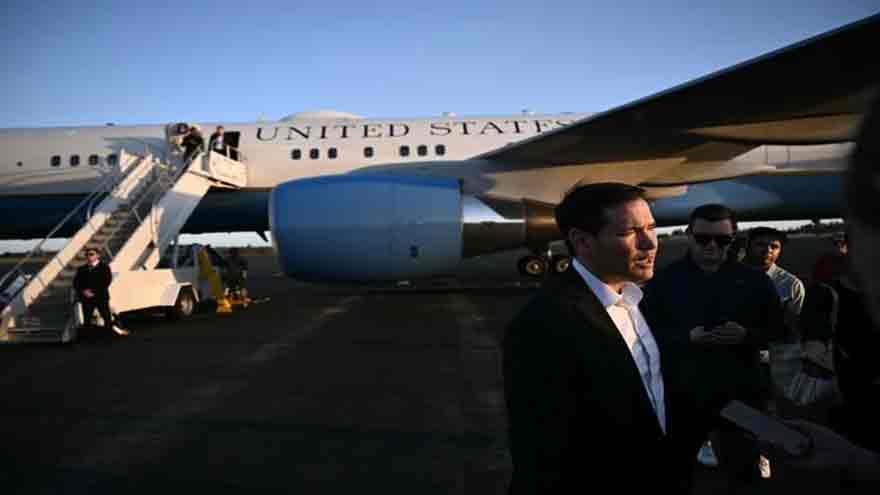
HOMESTEAD AIR RESERVE BASE, Florida (Web Desk) — U.S. Secretary of State Marco Rubio has defended President Donald Trump’s decision to launch military action against Iran, arguing that the conflict was necessary to prevent Tehran from developing nuclear weapons, even though the war has become politically unpopular in the United States.
Speaking to reporters in Florida on Sunday, Rubio said Trump had identified a serious national security threat and taken action to prevent Iran from pursuing nuclear weapons.
He acknowledged that confronting difficult security challenges is not always popular but argued that it can still be necessary for the country's protection.
Rubio's comments came after Republicans suffered significant losses in Tuesday's elections, with voters expressing dissatisfaction over Trump's policies, the ongoing Iran conflict and its economic consequences.
The war's impact on gasoline prices and the broader economy has become a major political concern, contributing to Democratic gains and increasing pressure on the Trump administration.
Rubio's Defense of Trump's Iran Policy
Asked about Vice President JD Vance's recent social media comments, which largely attributed Republican electoral losses to the Iran war, Rubio avoided directly addressing the election results.
Instead, he emphasized that Trump had acted to address what he described as a genuine threat from Iran's nuclear ambitions.
Rubio's position appeared to differ from Vance's assessment of the political consequences of the conflict, highlighting potential differences within the Republican leadership as speculation continues about their possible 2028 presidential ambitions.
Trump also defended his decision to launch the military campaign, saying that preventing Iran from obtaining nuclear weapons would be remembered as one of the most important actions taken during his presidency.
Iran's Nuclear Programme Remains a Major Concern
The Iranian nuclear programme remains at the centre of tensions between Washington and Tehran.
According to the International Atomic Energy Agency (IAEA), Iran possesses approximately 440.9 kilograms of uranium enriched to 60% purity. This is significantly above the enrichment level required for most civilian nuclear applications and technically closer to the 90% level generally associated with weapons-grade uranium.
Iran has consistently maintained that its nuclear programme is peaceful and intended for civilian purposes.
The United States, however, has continued to raise concerns about Tehran's nuclear activities and the possibility of the country developing nuclear weapons.
Strait of Hormuz Disruptions Push Up Energy Prices
The conflict has also created economic challenges, particularly through disruptions to shipping in the Strait of Hormuz.
The strategic waterway is one of the world's most important energy transportation routes, with approximately one-fifth of global oil supplies passing through it before the war.
Disruptions to commercial shipping have contributed to higher energy prices, putting additional pressure on American consumers and businesses.
Rising gasoline prices have become a significant political issue for the Trump administration, particularly as voters express concerns about inflation and household expenses.
US-Iran Ceasefire Negotiations Face Challenges
Despite continuing military tensions, diplomatic efforts are underway to prevent the conflict from escalating further.
Mediators, including Qatar, have been working to revive negotiations between Washington and Tehran. Iran is reportedly reviewing proposals aimed at resolving disagreements over its nuclear programme and the conditions for a ceasefire.
However, significant obstacles remain.
Iran has reportedly demanded that the United States:
End its blockade of Iranian ports.
Lift economic sanctions.
Unfreeze Iranian financial assets.
Provide compensation for war-related damage.
End hostilities across the region, including Israeli military operations in Lebanon.
Rubio said there was no immediate prospect of a major diplomatic breakthrough, describing several Iranian demands as unacceptable and unrealistic.
He nevertheless reiterated that Trump preferred a diplomatic resolution if a sufficiently strong agreement could be reached.
Trump Warns of Further Military Strikes
In a separate interview with CNN on Sunday, Trump said renewed military strikes against Iran were unlikely if negotiations produced meaningful progress and resulted in a strong agreement.
However, he warned that the United States had already identified potential military targets, including 38 bridges, should hostilities resume.
Meanwhile, the U.S. military has continued limited operations against Iranian targets, including air defence systems. American forces also fired on and disabled a commercial vessel on Saturday that Washington said was attempting to breach its naval blockade of Iranian ports.
Rubio defended the possibility of further defensive military action, saying the United States had the right to protect its forces and commercial shipping if directly threatened.
Uncertainty Surrounds the Future of the Iran Conflict
With no clear timetable for ending the war, tensions remain high across the Middle East.
The United States continues to emphasize the need to prevent Iran from obtaining nuclear weapons, while Tehran maintains demands for sanctions relief, compensation and an end to regional military operations.
Although diplomatic negotiations offer a possible path toward de-escalation, disagreements between the two sides remain substantial.
For now, the future of the US-Iran conflict will depend on whether Washington and Tehran can reach an agreement that addresses their competing security and political demands.